Your Electric Bill Is Subsidizing the AI Buildout
Power is now the binding constraint on AI. New power plants take years to build, data centers can outbid every other buyer for what exists, and businesses and households are paying for the gap


I knew moving to New Jersey meant high property taxes. I didn't know it meant helping finance the AI buildout. In 2025, the state's average residential electricity price rose 18.4%, to nearly 23 cents per kilowatt-hour. The independent market monitor for PJM, the regional grid operator, named data-center growth as the main driver of higher prices in its 2025/26 capacity auction. Because that auction prices in forecast demand, households from New Jersey to Illinois are helping cover the power needs of data centers that, in many cases, have not been built yet.
For over two decades, the digital economy grew without friction. "Bits over atoms" was the mantra, and the cloud scaled infinitely as long as the budget was there. AI just broke that illusion. Today, training and deploying intelligence requires massive compute clusters with industrial-scale electricity supply. As foundation models hit parity and chips commoditize, it is access to electricity that will determine how many large-scale AI data centers can be built. Data centers are projected to surge from under 5% of total U.S. electricity consumption to as much as 15% by 2030. Yet this rapid expansion exposes the severe limits of an aging grid, in turn compounding the financial strain on a public that has already absorbed a 33% jump in electricity costs since 2019.
The obvious answer is to build more power plants, and eventually we will. The real issue is who pays while we wait, and right now that's anyone who shares a grid with a data center.
The Mandate to Move First
Like the Manhattan Project, the AI buildout rests on the prospect that a technological breakthrough could alter the balance of global power. The White House’s July 2025 AI Action Plan makes that ambition explicit, linking AI leadership to global standard-setting and economic and military advantage. It pushes faster defense adoption, with China as the principal strategic rival.
The race is driven by a bet on artificial general intelligence and its capacity to improve itself. A system that automates frontier AI research could develop its own successors, shortening the interval between breakthroughs. The first nation to achieve this could compound its lead while rivals are still building systems to match its last advance.
That possibility gives governments a powerful incentive to accelerate. Yet as AI hardware and models proliferate, the advantage increasingly belongs to those able to power them at scale.
Why AI Wins the Energy Bidding War
Traditional workloads land between $1,800 and $3,900 per megawatt-hour. Frontier AI lands between $8,900 and $12,100, two to three times wholesale price cap, the most a megawatt-hour of wholesale power can cost there even during a shortage. An AI operator can pay whatever the market charges and still profit.
Electricity must be supplied exactly when and where it is consumed. Because battery storage remains costly at scale and long-distance transmission lines take years to build, power is fundamentally a regional commodity.
In these regional markets, grid operators run the cheapest plants first, turning on costlier ones as demand rises. The last, most expensive plant needed to keep the lights on sets the price for everyone. Customers also pay to maintain a standby reserve of power plants for peak demand. Because that reserve is sized to anticipated growth, simply forecasting massive AI energy needs drives up costs for everyone.
Building new power plants takes years, so AI operators are increasingly cutting to the front of the line by buying up existing supply. In June 2025, Talen Energy agreed to supply Amazon Web Services with up to 1,920 megawatts from Pennsylvania's Susquehanna nuclear plant. While the exact terms of these private power-purchase agreements are often shielded, the AWS deal was reportedly worth $18 billion. It drops a massive new consumer onto the grid without adding a single megawatt of new generation, leaving every other ratepayer to compete for what remains.
In a competitive market, supply should eventually catch up with demand and restore price equilibrium. AI demand keeps moving the target. Its economic value increases as models continue to scale, a feedback loop that keeps demand high. The four largest hyperscalers are on track to spend roughly $720 billion on capex in 2026, nearly double the prior year. Lawrence Berkeley National Laboratory’s June 2026 update, revised to account for power-intensive AI accelerators, puts data centers at 9.5–15.3% of U.S. electricity by 2030, up from 4.7% in 2024. Given the supply constraints below and the regulatory friction on top of them, equilibrium is several years away unless demand falls unexpectedly
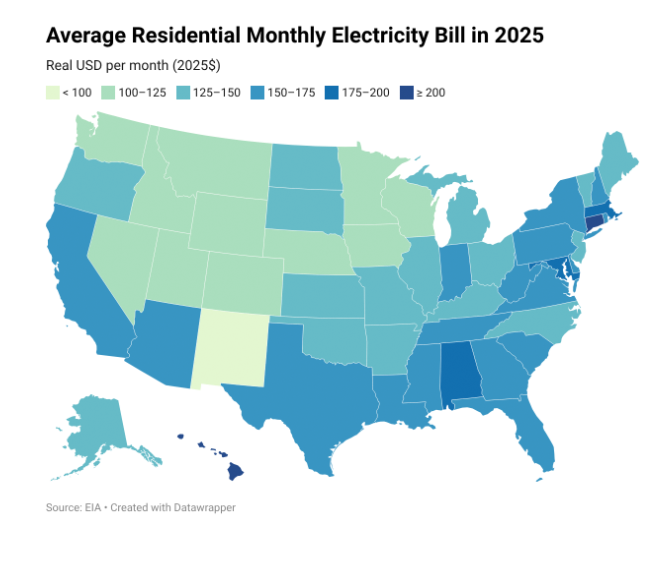
Change in Price per kWh from June 2025 to June 2026 by State.
From Transformer Backlogs to Copper Shortages
The difficulty of building new electrical capacity raises the strategic value of locations with dependable power already available.
Data centers run around the clock, so they need firm power that solar and wind can't guarantee on their own. New gas and nuclear capacity takes years to deliver. The EIA’s engineering study estimates construction alone at roughly three and a half years for a combined-cycle gas plant and seven years for a large nuclear addition at an existing site, before accounting for the full development process or equipment delays.
Large power transformers are another critical bottleneck in expanding the grid. These custom-built units adjust voltage so electricity can move over long distances and reach local users. In March 2026, Department of Energy officials reported procurement lead times of three to four years. Manufacturers are investing in capacity, but relief takes time. Hitachi Energy’s Mississippi factory, announced in September 2026, targets initial production in 2029.
The constraints go down to raw materials, particularly copper, which is essential to cables, transformers, and generators. The IEA projects that primary copper supply could fall roughly 25% below global requirements by 2035. Permits and capital can be accelerated, but the grid still grows only as fast as its scarcest component.
The Cost of Atoms
When the Manhattan Project needed to produce fissile material at industrial scale, its planners started with a map. Oak Ridge, Tennessee, was chosen in part for access to the Tennessee Valley Authority's hydroelectric power. Hanford, Washington was chosen for the Columbia River and the electricity from the Grand Coulee and Bonneville dams. The most urgent national-security program of its era was built around power generation capacity. The difference from 1942 is that there is no wartime command economy setting capacity aside. Today's data centers draw from grids shared with households, hospitals and manufacturers, and the competition for that capacity is settled through price.
Where you sit on the grid is becoming a competitive variable. Energy-intensive firms in constrained regions face rising costs their rivals elsewhere avoid, and very few can negotiate the long-term contracts hyperscalers sign. A quarter of American households already spend more than 6% of their income on home energy, and most can't simply relocate to a different state.
Hyperscalers are starting to finance dedicated new supply, from reactor restarts to small modular reactor agreements, but most of it arrives late this decade or later. Until then, pooled capacity costs mean the buyers willing to pay more for power raise prices for everyone else. Regulators are already scrambling to intervene, with states drafting separate rate classes for data centers, and Congress proposing ratepayer shields.
But policy cannot legislate megawatts into existence and new pricing rules can slow the rise in household bills, but they can't stop it.