How "Vibe Coding" is Rewriting Software Development
The 'build vs. buy' debate is changing. Vibe Coding introduces a third option: Generate. AI is making it economically viable to solve niche business problems in-house with custom point solutions, rather than buying expensive enterprise platforms.

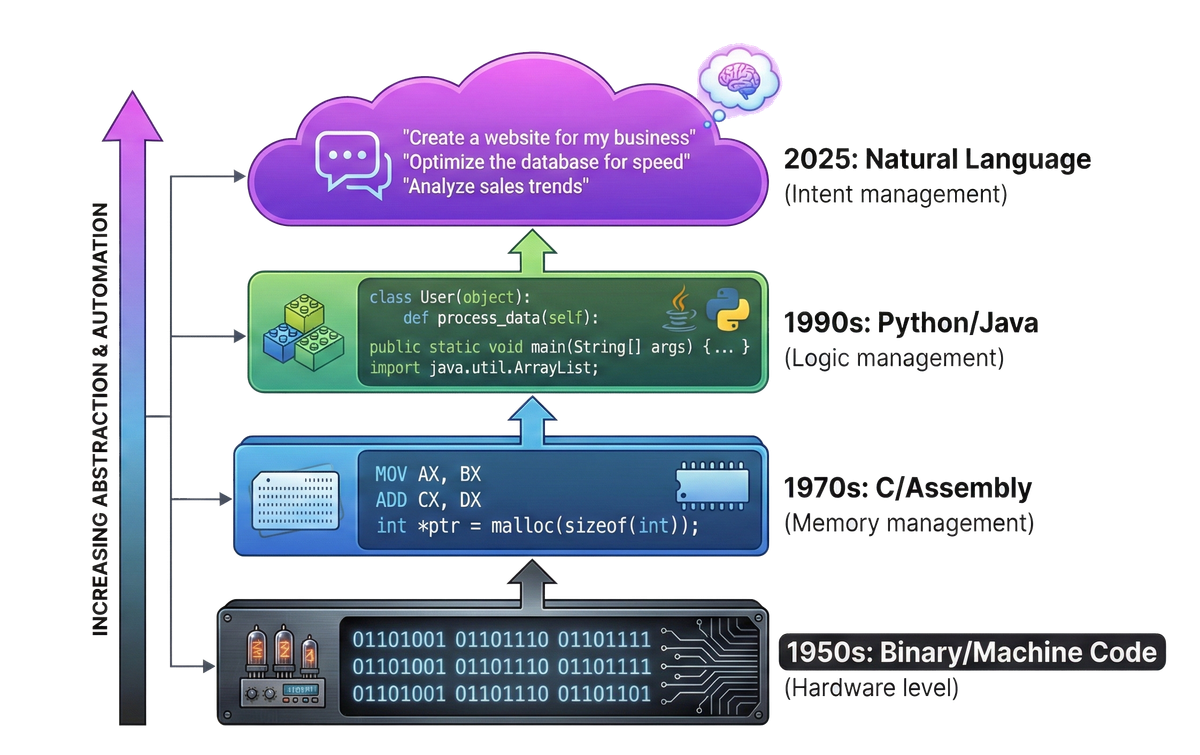
Coined by AI researcher Andrej Karpathy in early 2025, the term 'Vibe Coding' describes a new reality where human operators guide Artificial Intelligence to generate software through natural language prompts, effectively "forgetting that the code even exists".
This isn't just a new tool; it is a fundamental restructuring of the economics of software.
This revolution will have enormous business consequences, the full scope of which is only now becoming clear. Cheap, custom-built in-house solutions are poised to disrupt enterprise software vendors. Simultaneously, a vast array of business problems that were once too expensive to solve with software are now viable. The compounding value of just these two factors will be staggering.
The Zero Marginal Cost of Creation
In economics, when the marginal cost of a good hits zero, its nature changes. We saw this with the Internet and distribution: when the cost to distribute news hit zero, the newspaper industry collapsed, and the creator economy was born.
We are now witnessing the same phenomenon with software creation.
Venture capitalist Chris Paik has argued that we are approaching the "End of Software" as a business model. His thesis is simple but profound: if software is no longer expensive to build, it loses its "moat." The value of a SaaS company historically lay in the difficulty of replicating its codebase. In the vibe coding era, a competitor—or even a non-technical founder—can replicate a platform's functionality in a weekend. Just as we don't think twice about taking a digital photo because it costs nothing to produce, we will soon stop thinking twice about building an app.
The Rise of "Disposable Apps"
The current paradigm of software development is built on longevity. We write "clean code" and use rigid frameworks like React or Django because we expect the software to last for years. We need other humans to be able to read it, update it, and patch it. Vibe coding enables the "Disposable App". Imagine you need to analyze your Q3 sales data. Instead of buying a complex BI tool, you ask an AI agent to "spin up a dashboard that visualizes this spreadsheet." The AI writes the code, deploys a micro-app, you use it for an hour to find your insights, and then—crucially—you delete it.
Next quarter, you generate a new one. It will be better, because the underlying AI model will have improved. In this world, technical debt is a concept that applies only to legacy infrastructure. For the user, the application is just a temporary bridge to an outcome.
Our organization is already utilizing AI to build targeted tools for niche problems that traditional development cycles simply couldn't afford to prioritize.
English as a Programming Language
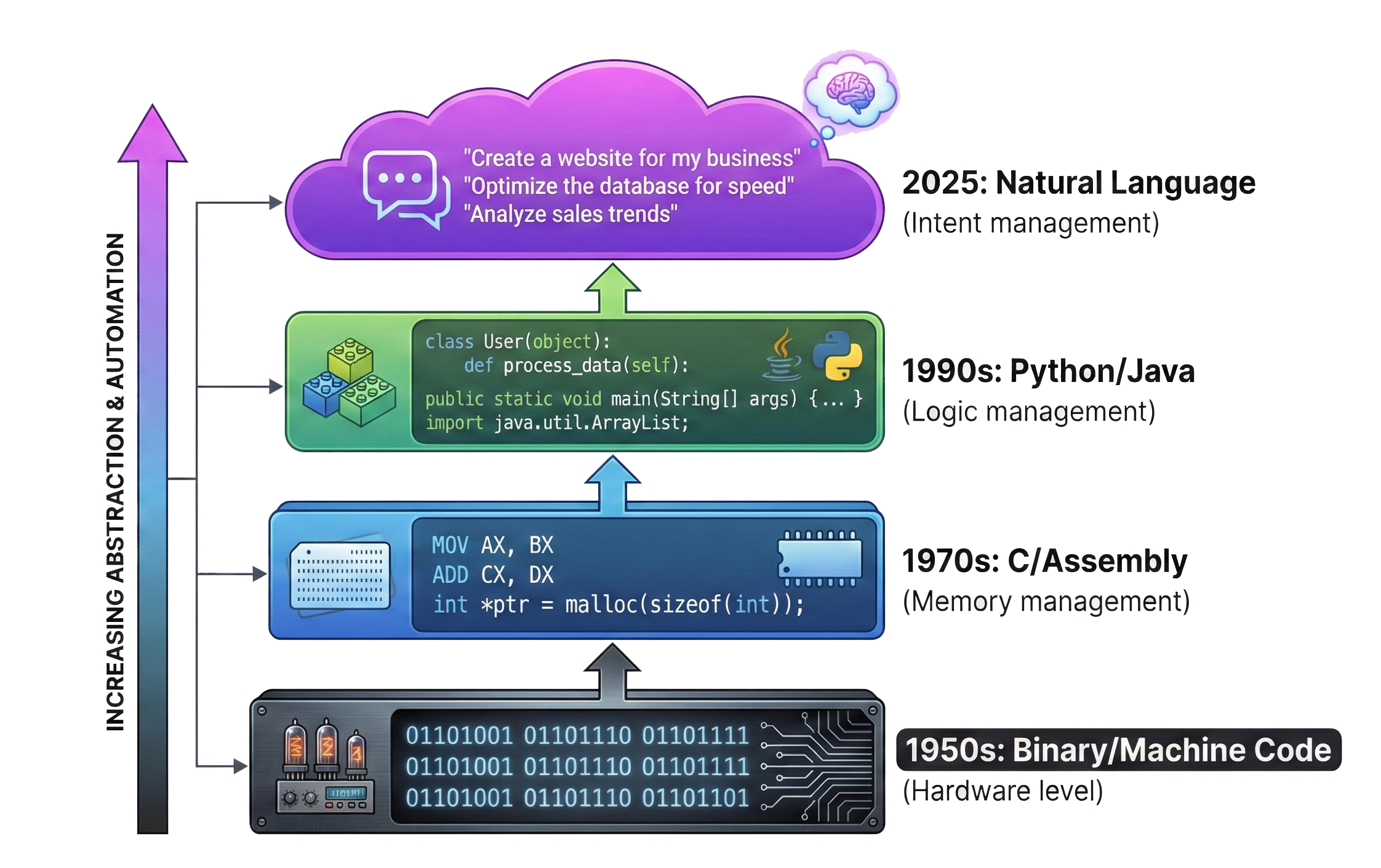
Critics, like Simon Willison, argue that natural language is too ambiguous to replace code entirely. They note that "vibe coding" without understanding the underlying syntax creates security risks and unmaintainable "spaghetti code". They are right, but perhaps only for the short term.
Working with agentic Coding platforms such as Claude Code or Google Antigravity, it becomes clear that AI is quite good at converting high-level natural language instructions into code that behaves the way you expect it to. Using its intuition to feel the gaps left by the lack of formalism.
No doubt natural language specification standards will begin to emerge, that will ensure instructions provide all information needed for AI and minimize ambiguity.
There is an argument to be made that now that its AI doing the coding, it should just use the best tool for the job, and go straight to the lower level language such as C or assembly.
Impact on the Labor Market
Developers have adjusted to the new reality rather quickly. According to the 2025 Stack Overflow developer survey, 84% of respondents use AI tools as part of their development process.
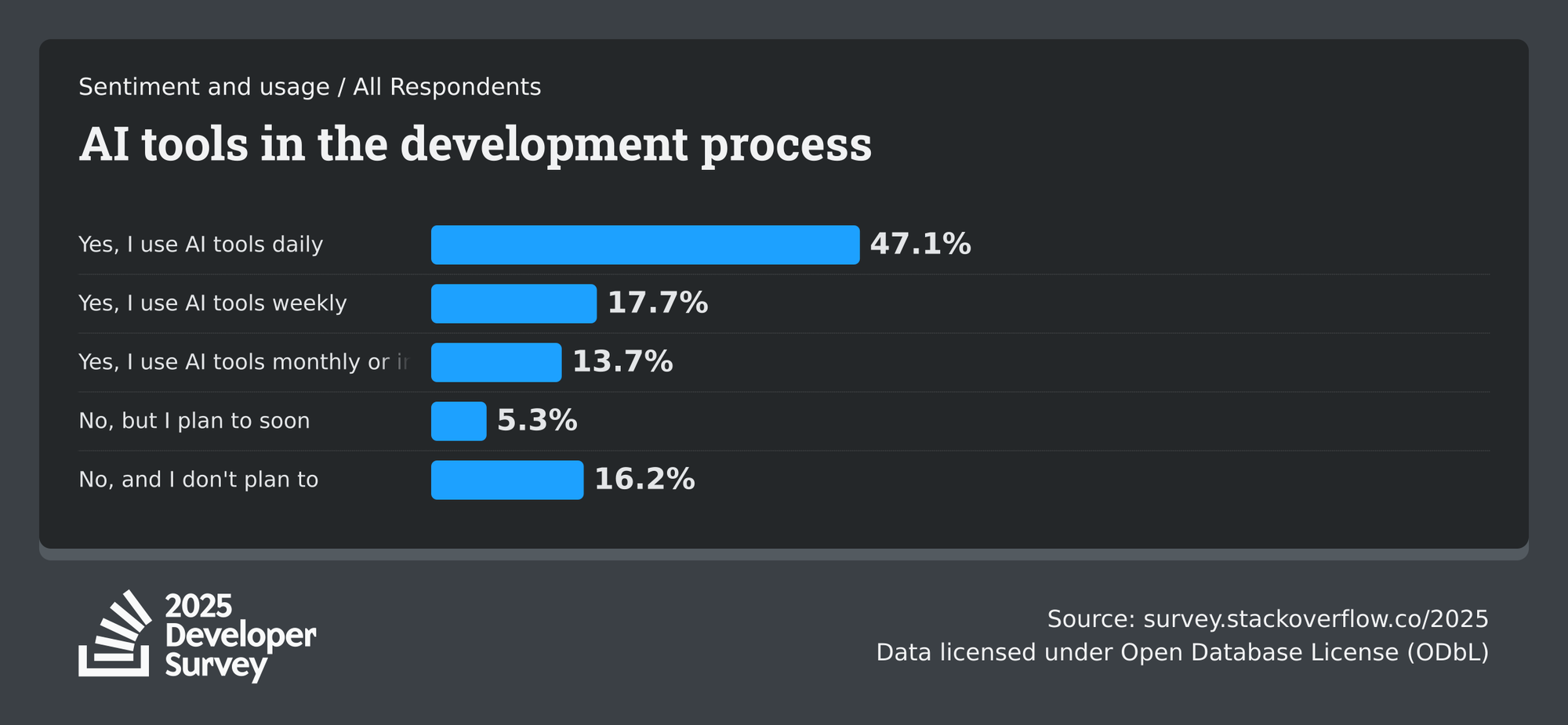
Without a doubt, code generation is the area where AI is making the most impact on business right now. As the tools continue to quickly mature, expect further productivity gains from leveraging AI code generation tools.
Despite greater automation, the demand for developers is not going anywhere but up. US Bureau of Labor Statistics expects 15–18% growth in total software developer jobs from 2024 to 2033. Recent data from Lightcast, shows that job postings for engineers with 0–3 years of experience have grown by 47% since October 2023.
Security and Trust
"Vibe coding" implies some surrender of control—Karpathy describes it as "giving in to the vibes". But in enterprise environments, "vibes" don't pass security audits.
Although the thought of deploying systems that are not fully understood sounds scary, the risks can largely be mitigated. AI coding tools can be instructed to follow existing architecture and development guidelines. Verifiable test cases can be generated separately from the system and be used to test each version. Another emerging technique is to use Adversarial Auditor AI agents —specialized models trained solely to find bugs and security flaws in the code. For example, at my organization, we are using different AI models to review code than the ones used to develop it.
The Outlook
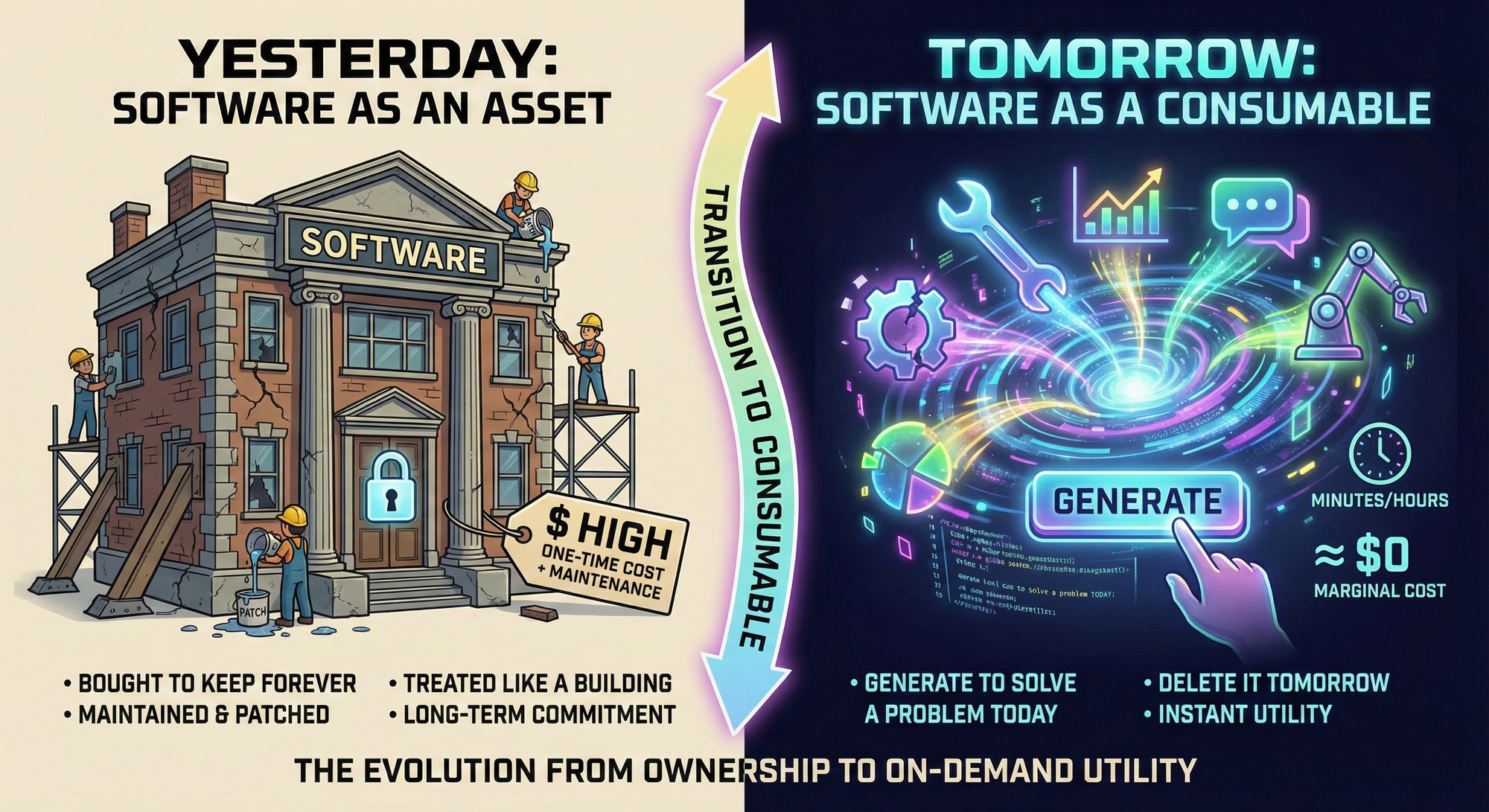
The democratization of software creation is not just a deflationary force for the cost of code; it is an existential threat to the current model of selling it.
For the last two decades, the software industry was built on the SaaS Assumption: that building robust software is hard, so customers should rent a "one-size-fits-all" solution from a vendor who spreads the engineering cost across thousands of users. Vibe coding invalidates this assumption.
As the cost of creation approaches zero, the economic justification for massive, monolithic enterprise software evaporates. Why pay $100k a year for a rigid ERP system when your internal resources can vibe-code a bespoke solution—perfectly tailored to your specific workflow for dollars?
We are not just witnessing the acceleration of development; we are witnessing the end of software as a fixed product.