The Future of Education
The half-life of a learned skill is shrinking; adaptability is the only safety.

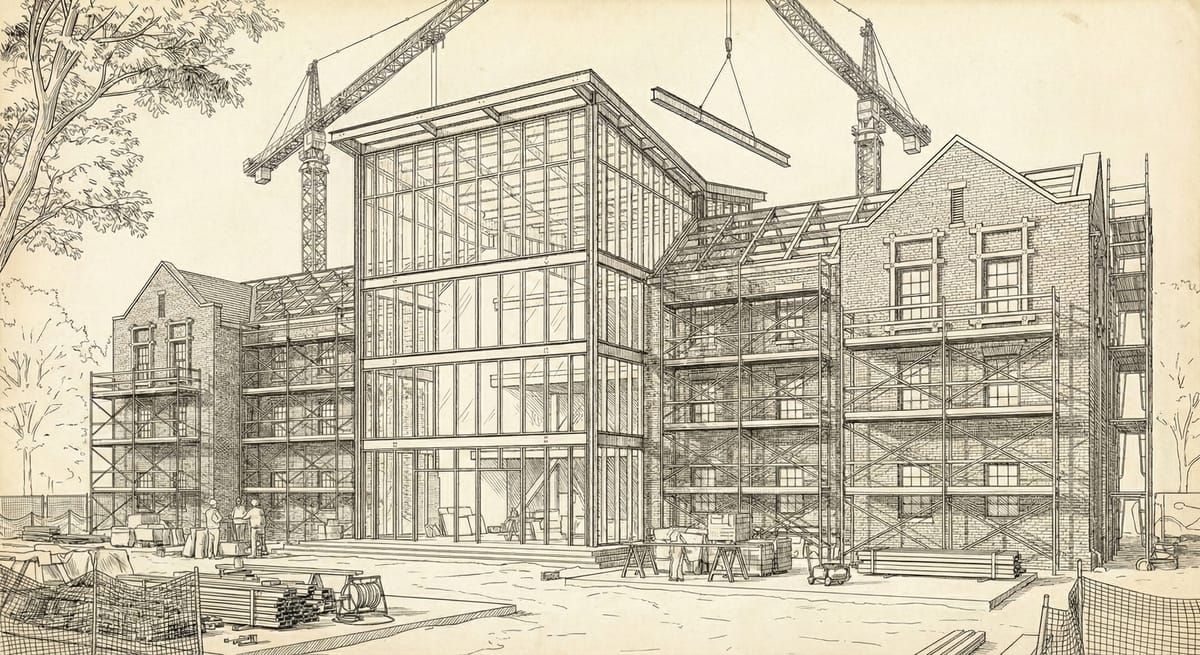
- The Unbundling: AI is dismantling the traditional university bundle: knowledge, network, credentials.
- Learning Velocity: The most important skill in the AI era is how fast you can learn, pivot, and build. The half-life of a learned skill is shrinking; adaptability is the only safety.
- The Value Shift: We are moving from an economy of Process (implementation) to an economy of Intention (knowing what to do and why).
- The New Moat: As technical barriers vanish, the only enduring human advantages are Taste (curation) and Character (resilience forged through friction).
While speaking to MBA graduates at Hofstra University recently, I got asked about what majors I thought were were safe in the age of AI. I actually think there is a bigger question that universities need to answer us: what is the new role of higher education?
For the better part of a century, the university model has been the Golden Ticket of modern civilization. It was a sturdy, reliable black box: you put in tuition and four years of your life, and you popped out the other side with a career, a network, and a stamp of approval. It was a model built for a world of scarcity—scarcity of books, scarcity of experts, and scarcity of access.
But if you have been paying attention to the exponential curve of Artificial Intelligence, you know that this black box is leaking. The structural integrity of higher education is fracturing, not because the teachers are ineffective or the students are lazy, but because the economic reality of intelligence has fundamentally changed.
Here is why the university of the future looks nothing like the past.
The Great Unbundling
To understand the disruption, you have to understand what universities actually sell. Historically, they haven’t just sold education. They sold a bundle of three distinct products wrapped in a high price tag:
- Access to Knowledge: The lectures, the library, and the curriculum.
- Talent Networks: The peer groups, alumni connections, and social signals.
- Credentials: The degree that validates your worth to the labor market.
For a long time, you couldn't get one without buying the others. But AI is the ultimate unbundler.
The internet started chipping away at the first pillar years ago, but AI has essentially nuked it. Intelligence is now manufacturable at scale. Universities are no longer competing with each other; they are competing with a global Intelligence Factory that runs 24/7, costs pennies, and adapts instantly to the specific needs of the user.
When knowledge is free and intelligence is cheap, the premium on access drops to zero. The university bundle is coming apart, forcing institutions to justify why a student should pay $50,000 for a lecture they can get from a bot that explains it better, faster, and cheaper.
The Shift from Implementation to Intention
Perhaps the most profound shift for learners today is the movement from the Cost of Process to the Value of Intention.
In the Old World (the one most of us grew up in), the barrier to entry was implementation. To be an engineer, you needed to know the syntax. To be a designer, you needed to master the Adobe suite. To be a writer, you needed to master grammar and structure. The education system was designed to drill these processes. The question was always: "Can you do it?"
In the New World, the machine handles the implementation. The syntax, the brushstrokes, and the grammatical structures are commodities. The barrier to entry has shifted. The new question is: "Do you know what to do, and do you know why it matters?"
We are moving into an era of high-leverage generalists. The technical ability to execute is being replaced by the visionary ability to direct. If you can clearly articulate an intention, AI can bridge the gap to the outcome. This turns the education model on its head. We don’t need to spend four years teaching students how to turn the crank; we need to teach them what the machine should be building. The value is no longer in the answer; it is in the quality of the question.
The Devaluation of the Degree
So, what happens to the piece of paper?
As verification of skills becomes cheaper, the degree loses its power as a gatekeeper. We are transitioning from a world of Credentials to a world of Portfolios.
In the past, an employer relied on a degree from a top-tier university as a proxy for competence. It was a lazy but effective filter. But today, AI-assisted outputs, simulations, and digital trails provide a much higher-resolution signal of what a person can actually do.
The market is ruthless. It will always prioritize demonstrated capability over a four-year signal that is often structurally outdated by the time the ink dries. The degree is becoming a preference, like a luxury good, rather than a prerequisite for economic participation. Employers are beginning to look for Proof of Work—GitHub repos, written essays, launched projects—rather than Proof of Attendance.
Character and Taste
If AI takes over implementation, logic, and information retrieval, what is left for the human?
The analysis argues that the future of human value lies in two things that cannot be downloaded: Taste and Character.
Taste is the ability to distinguish the meaningful from the mediocre. When AI can generate infinite content, the value shifts to curation. Knowing what is good is now more valuable than knowing how to make it. It is the editor's eye, the director's cut, the ability to discern quality in a sea of synthetic noise.
Character is forged through friction. It is built through struggle, failure, and persistence. AI offers a frictionless path to answers, which is efficient for productivity but terrible for character development. The educators of the future won't just be content broadcasters; they will be designers of desirable difficulties. They will be mentors of identity who help students navigate the struggle of learning, because that struggle is the only place where resilience is born.
We are returning to First Principles Thinking. We have to strip away the assumptions of the last century and build solutions based on fundamentals.
The Redefinition of Roles
This shift forces a complete reimagining of the roles within the educational ecosystem.
- Teachers: No longer broadcasters of content, they become designers of learning experiences. Their job is to mentor identity and facilitate the messy, human process of debate and discovery.
- Assessment: We must move away from rubrics and exams that measure memory. The future of assessment is measuring thinking, reasoning, and decision-making under uncertainty.
- Learning Velocity: The most important skill in the AI era is how fast you can learn, pivot, and build again. The half-life of a learned skill is shrinking; adaptability is the only safety.
Conclusion
There is no safe major. There is no safe career path that is immune to automation. In a world of abundant information and cheap intelligence, the rarest and most valuable traits are direction, taste, and courage.
The university isn't disappearing, but it is being forced to evolve. For the learner, the message is clear: The bundle is broken. You are now the architect of your own curriculum. Find a domain you care enough about to go deep, leverage the machines to handle the process, and focus your humanity on the intention.
Jensen Huang has a recent video that speaks to many of these issues that is worth a watch.